From Local Cinema to Screen Location: A Short History
Trace how northern places shifted from cinema halls and production settings into screen stories, and learn which historical lens best fits your viewing.
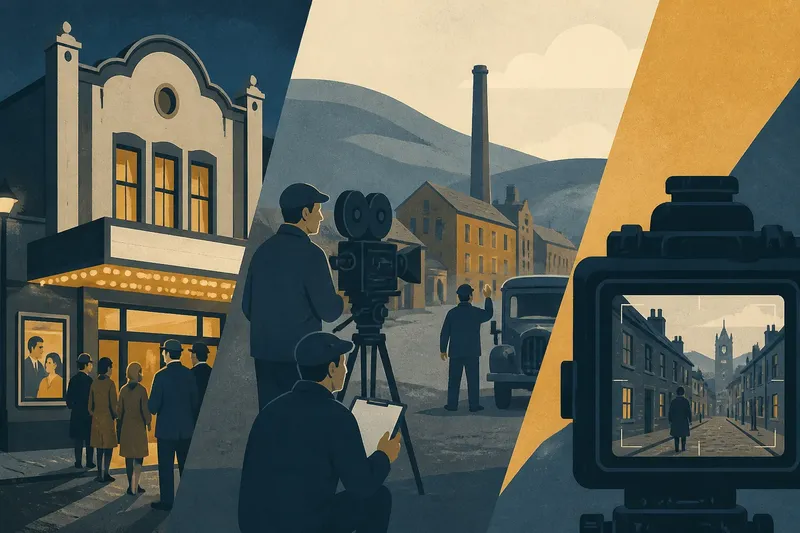
The common mistake in tracing northern screen history is to treat a cinema building, a film studio and a location on screen as interchangeable evidence. They tell different stories: one is about where people watched, another about where crews worked, and a third about how a place was made to mean something in a film. Keep those distinctions in view and the journey from local cinema to screen location becomes easier to read.
That journey is not a neat procession in which exhibition gave way to production and production gave way to storytelling. These roles overlapped, disappeared and returned in different forms. A town might have a busy picture house without hosting a production; a film could be shot in a region but tell a story that scarcely acknowledges it. The right historical lens depends on the question you bring to the screen.
Which part of the story are you trying to see?
If you are interested in how audiences encountered moving pictures, start with exhibition. If you want to understand how northern places entered film production, look at studios, crews and location work. If you want to know how a place became part of a film’s meaning, follow the screen image: streets, accents, weather, work and local relationships.
These are not competing accounts. They are different routes through the same history, and each leaves different traces. A surviving cinema façade can tell you where people gathered, but not by itself what they watched or how a film used the town beyond its doors.
- Choose exhibition history if your question is about audiences, local entertainment or the social life of cinema.
- Choose production history if your question is about crews, facilities, local labour or why a location was selected.
- Choose screen representation if your question is about what a northern place looks and feels like in a story.
- Combine the three if you are following one town across its cinemas, working sites and appearances on screen.
What does a local cinema reveal?
In the early decades of cinema, local exhibition made film a regular part of town life. Audiences gathered in purpose-built picture houses, converted halls and other venues adapted for screenings. The buildings varied, but their role was more than simply showing a film: they brought a new form of entertainment into familiar streets and made watching a shared local occasion.
To read this layer of history, look for the building’s changing uses as well as its original function. A cinema might have become a shop, a bingo hall, a community venue or a derelict shell. Its altered frontage can obscure the old purpose, while traces such as a broad entrance, a former projection-room window or local memories may help identify it. Treat these clues as prompts for further checking, not as a complete record.
Exhibition history also asks who could attend and what the visit meant. A cinema’s programme, opening arrangements and position within the town could shape its audience. Evidence may survive in local newspapers, council records, surviving programmes, photographs and oral histories. Each source has limits: a publicity notice tells you what was advertised, not necessarily who came through the door.
Choose this lens when the centre of your interest is the audience rather than the image. It is especially useful if a film appears in local memories as an event, or if you want to understand how cinema became part of a community’s ordinary rhythm. It will not, on its own, explain why a later film chose a particular street as its setting.
When did northern places become production settings?
Production can happen far from the places a film depicts. Early and later screen work alike could rely on sets, studio facilities, existing buildings or locations selected for their resemblance to somewhere else. Northern places entered production in several ways: as the actual setting, as a practical substitute, as a source of local workers and services, or as a place whose appearance could be reshaped by camera and editing.
That distinction matters because a film’s location is not automatically its story’s location. A crew may choose a street for its light, access or architectural character while setting the action elsewhere. Conversely, a film may be set in a northern city but use locations from several places. Production records, location photographs and credits can help separate where filming took place from what the film claims its setting to be.
Local participation is another part of the production story. Residents might appear as performers, provide accommodation or transport, assist with practical arrangements, or simply adapt to a crew working nearby. Their involvement can leave a different historical trace from the finished film: a local notice, a photograph, a memory of a temporary closure. Such evidence shows contact between production and place, though it does not establish how much influence residents had over the final work.
Choose this lens if you are curious about the practical movement of filmmaking through a region. It suits questions such as why a production came to a particular town, what local resources it used, and which places stood in for others. It is less suited to judging how convincingly the finished film represents the people who live there; that is a question about the screen image.
How did the location become part of the story?
A location becomes more than a backdrop when the film’s choices make its character matter. A mill, harbour, estate, hillside or row of terraces can establish work, class, distance, belonging or conflict without a character spelling out the point. The camera may dwell on a route through town, return to a recognisable junction, or frame a familiar building differently as the story changes.
That screen meaning is constructed. Framing can exclude nearby streets; sound can make a quiet place feel threatening; editing can compress a long journey into a few cuts. Weather, dialect and local routines may lend a scene a specific texture, but they do not automatically make the portrayal accurate or representative. A film’s version of a place is an interpretation, not a transparent record.
Look for what the story asks its locations to do. Does a street connect characters to work, or separate them from it? Does a landscape offer escape, expose isolation or mark a boundary? Are local interiors shown as lived-in spaces, or used briefly as signs of hardship or charm? These questions keep attention on the relationship between place and story rather than treating recognisability as the only measure.
Choose this lens when you want to discuss a film’s sense of place, or when a location seems to carry an emotional or social role. It is also the best route for understanding why two films shot in the same town can make that town feel entirely different. The place may be shared; the stories, camera decisions and points of view are not.
Which historical lens fits your question?
How can I tell where a film was actually shot?
Separate the stated setting from the production location, then compare credits with local records, production photographs or reliable location listings. A recognisable building is a useful clue, but streets and interiors can be altered, dressed or combined to suggest a different place.
Does a film set in the North count as northern cinema?
It can, but the answer depends on what you mean by the term. A northern setting may be central to the story even when the production took place elsewhere, while a film made in the North may give the region little presence on screen.
What sources help with a former local cinema?
Try local newspaper archives, library collections, historic photographs, council records and memories gathered by community groups. Read them alongside the building itself: a changed use or façade can preserve clues, but no single source is likely to explain the whole venue’s life.
Why do some locations feel more vivid than others?
Films give places different amounts of attention and connect them to different characters, sounds and events. A recurring route or a carefully framed workplace can gather meaning as the story develops, while a location shown only as passing scenery may remain indistinct.
What changes when the three histories meet?
Some northern places can be followed through all three lenses, though the evidence may be uneven. Imagine you are tracing a former picture house in an invented coastal town: you find an old programme in a library, a local archive photograph showing its entrance, and a later film credit listing the town as a production location. The programme and photograph help explain the venue’s exhibition role; the credit points towards production, but you would still need to watch the film or consult location records to learn whether its story actually uses that town.
This is a useful way to avoid making one object carry too much history. A cinema building cannot stand in for every audience who attended it, and a filming credit cannot tell you how residents appear in the finished story. Let each source answer the question it can reasonably answer, then connect the answers where the evidence supports it.
For a broader account, follow the changing relationship rather than searching for a single origin point. An exhibition venue might be absorbed into a town’s cultural memory even after it closes. A production might bring temporary activity to a place without changing its screen image. A later film might draw on local recognition while presenting an invented version of the region.
How should you choose a route through this history?
Begin with the object that prompted your curiosity. If it is a building, ask whether you want its life as a cinema or its later appearances in film. If it is a scene, ask whether you are tracing the filming location or interpreting what the place does in the story. If it is a town’s screen reputation, compare production choices with the ways films represent its residents and spaces.
Then match the question to sources. For exhibition, seek programmes, newspaper listings, building records and local memories. For production, look for credits, location photographs, crew information and contemporary notices. For screen representation, return to the film itself and pay attention to framing, sound, editing and the work assigned to place in the narrative.
From local cinema to screen location is not a simple change from one use of place to another. It is a history of overlapping encounters: audiences meeting films in familiar streets, productions borrowing and working within northern settings, and stories turning selected places into signs of home, distance or change. The most revealing account is usually the one that keeps those encounters distinct long enough to see how they touch.
When you search for local cinema history, decide first whether you mean a venue, a production or a place’s screen identity. That small distinction makes archives easier to read and keeps the town itself from being reduced to a backdrop.