A Street of Shopfronts or a Row of Towers?
See how shopfront streets and tower blocks shape movement, privacy and everyday encounters in northern films, and what each setting lets a story reveal.
The most common mistake in reading a city film is to treat its streets as interchangeable scenery. A shopfront street and a row of residential towers organise movement, privacy and chance encounters in sharply different ways; noticing that difference helps explain why a scene feels exposed, intimate or full of possibility.
In northern cinema, urban settings can carry the pressure of weather, work and shared public space without announcing themselves as symbols. A camera following someone past a bakery, a bus shelter and a shuttered launderette gives one kind of social map. A lift rising past identical landings gives another.
What does each kind of street make visible?
A shopfront street puts daily activity close to the pavement. Doors open directly onto public space, windows display goods or domestic glimpses, and people can pause without having a formal reason to meet. The film can let a character’s route cross the paths of customers, neighbours, delivery workers and passers-by.
That visibility is not the same as openness. A shop window may reflect the street while hiding the interior; a half-lowered shutter can suggest that a familiar place has changed its hours or its fortunes. The camera can frame a character between glass and pavement, making them both part of the street and separate from it.
Towers organise visibility vertically. Balconies and windows look across gaps, while shared entrances, lifts and landings funnel residents through spaces that belong to no one household. A character may be surrounded by other people yet have little reason to speak to them, or may hear a neighbour through a wall without seeing them at all.
These arrangements give a director different ways to show social proximity. On a commercial street, a brief exchange can begin because someone recognises a face behind a counter. In a tower, contact may hinge on waiting for a lift, sharing a landing or noticing that a familiar door has stayed closed.
How does movement change between pavement and landing?
A street usually offers several directions at once. A character can turn into a shop, cross to the opposite pavement, keep walking or stop at a bus stop. A tracking shot along shopfronts can make those choices legible, while a static frame can let the character move in and out of a busy background.
Shopfronts also give movement a rhythm. A person may slow at a display, speed up past a closed premises or pause to speak through an open doorway. The sequence need not explain the neighbourhood; the changing pace of the walk gives viewers clues about which places attract attention and which are being avoided.
Towers tend to concentrate movement into thresholds: the entrance, the lift, the stairwell, the landing and the front door. A camera waiting inside a lift can turn an ordinary ride into a held encounter, while a view from the stairwell may show someone arriving before they reach their flat. Even a short journey can feel consequential because leaving the building and returning to it are distinct passages.
Neither setting dictates a single mood. A street can feel restrictive if a character is watched by people who know them, while a tower’s height can offer a sense of distance from street-level demands. The useful question is not which place is freer, but which movement the scene makes easy, difficult or noticeable.
When does public space become private?
Shopfront streets blur the boundary between public and private through glass, open doors and repeated encounters. A person can be visible without being available: a shopkeeper may recognise a customer but keep the conversation brisk, or someone inside may draw a blind against the street. These small gestures let a film show privacy as something negotiated in view of others.
Residential towers complicate the boundary differently. The entrance and lift are shared, but the flat door marks a strong division between communal space and home. A scene on a landing can therefore carry a particular tension: neighbours may be close enough to hear a disagreement yet uncertain whether to intervene.
Sound makes both arrangements richer. On a street, traffic, shop radios and conversation can mingle, with a single voice briefly cutting through the wash. In a tower, footsteps, lift machinery and muffled voices can travel through enclosed spaces, making unseen neighbours part of the scene’s atmosphere without turning them into visible characters.
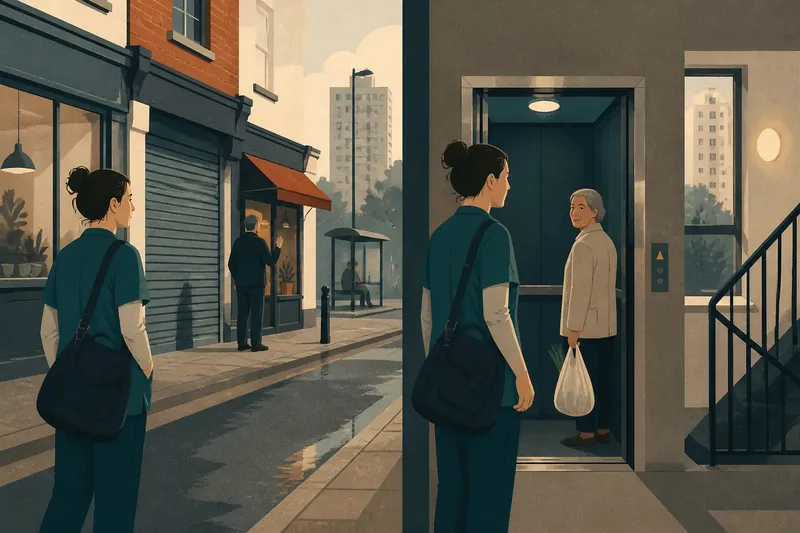
Imagine a fictional scene in which a young care worker returns to a northern neighbourhood after a long shift. On a shopfront street, she pauses outside a closed café and exchanges a wave with someone locking up next door; the expected result is a brief sense of recognition, even though she keeps walking. In a tower, she might instead hold the lift for a neighbour carrying shopping, producing a small, practical encounter that ends when the doors open on separate floors.
The starting point is the same: she is tired and heading home. The location changes who can notice her, where she can stop and how much conversation the scene can sustain. That is the setting doing dramatic work without needing a speech about community.
What does a film gain from shopfront streets or towers?
- Shopfront street: Use it to connect a character’s journey with local routines, visible work and accidental meetings.
- Tower entrance or lift: Use it to place strangers and neighbours in close quarters, with a clear point at which contact can begin or end.
- Shop window: Use reflections or displays to divide a character from the street while keeping both in one frame.
- Landing or stairwell: Use it to make arrivals, departures and overheard sounds matter without showing the whole building.
- Street-to-home transition: Use a doorway or entrance to mark the shift from public attention to private retreat.
These choices work best when they fit the character’s immediate task. Someone trying to avoid a familiar face may find a busy street less anonymous than expected. Someone seeking a quiet word may find a tower landing too exposed, even though it is physically removed from the pavement.
Which setting suits a scene about an encounter?
The choice depends on what kind of encounter the story needs. A shopfront street supports contact that is casual, repeatable and tied to ordinary errands: recognition at the counter, a question through an open door or a conversation paused by passing traffic. A tower supports contact shaped by shared access: waiting, yielding space, hearing someone arrive or deciding whether to knock.
For a director, blocking is as important as the building. On a street, two characters can speak while walking in parallel, separated by a shop window, or on opposite sides of a doorway. In a tower, they may be constrained by a lift’s limited space or kept apart by the threshold of a flat.
The distinction can also guide editing. Cutting between several shopfronts may suggest a character’s familiarity with a route, while staying in one lift or landing can make a pause feel unusually long. A film need not explain the architecture; the viewer reads its rules from where people are allowed to stand and how they move past one another.
What do viewers often ask about these city settings?
Why do shopfront streets feel more social in films?
They place workplaces and public routes beside one another, so a character can meet people while doing ordinary tasks. That impression depends on the scene: a quiet or closed street may instead emphasise absence and disconnection.
Do tower blocks automatically suggest isolation?
No. Their shared entrances, lifts and landings can create repeated contact, while windows and balconies can connect residents across the building. A film’s framing and character behaviour determine whether that proximity feels supportive, awkward or distant.
How can a film show privacy without entering a home?
It can use a shop window, a closed door, a drawn blind or a conversation that stops at the threshold. Sound can also suggest private life nearby while keeping the camera in a shared space.
What should I notice in a city scene?
Watch where characters pause, which routes they take and who can see or hear them. Then notice whether the setting offers several ways out or funnels everyone through the same point.
How can you read an urban setting on screen?
Start with the character’s route rather than the building’s appearance. Ask what they are trying to reach, where they slow down and what makes them change direction. A row of lively shopfronts may matter because the character must pass a particular doorway; a tower landing may matter because there is nowhere to avoid a neighbour.
Next, track the scene’s boundaries. Look for glass, shutters, entrance doors, lifts and windows, and note when a character crosses from one kind of space to another. These thresholds often reveal more about a film’s treatment of privacy than a panoramic view of the city.
Finally, listen for the people who remain outside the frame. Street noise may keep the wider neighbourhood present, while a lift’s hum or footsteps on a landing can suggest residents nearby. In either setting, what the camera does not show can be as telling as the face it follows.
When comparing shopfront streets and tower blocks in northern film, keep the focus on the scene’s practical arrangements: who can move, who can watch and where an encounter can happen. The setting becomes legible through those small permissions and interruptions. Once you notice them, even a walk to the door can reveal how a film imagines city life.