A Rewatch for the Journey Between Places
A rewatch for the journey between places reveals how routes, pauses and transitions shape a film’s rhythm and change what each arrival means.
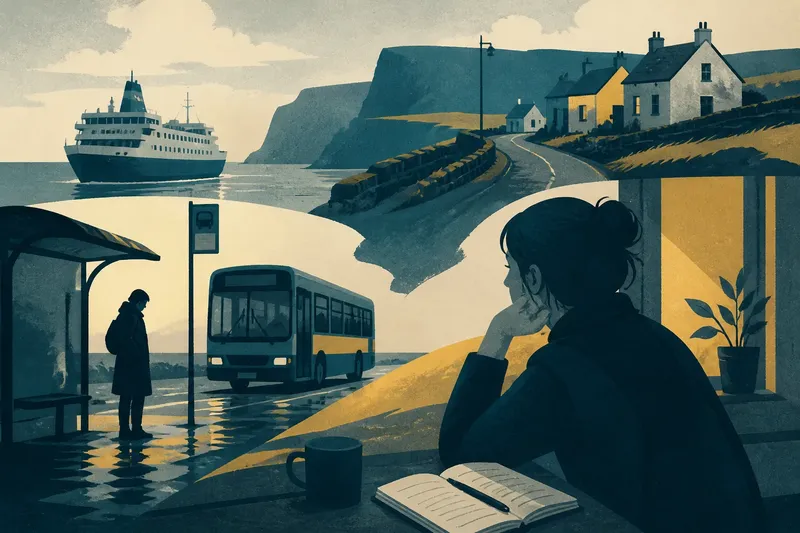
The common mistake in a rewatch for the journey between places is to treat every trip as connective tissue: the scene in town matters, the scene at the destination matters, and the road between them can be skipped. That shortcut can erase a film’s pulse. A ferry crossing, a long wait at a bus stop or a cut from one settlement to another may quietly change the story’s pace, mood and sense of distance.
Try following movement rather than plot. Keep a notebook or use the notes app on your phone, and mark where a character starts, what carries them onwards, where the film makes them wait, and what feels different when they arrive. The aim is not to map every street. It is to notice how the journey edits the story.
What counts as a journey in a film?
Start with the obvious routes: a train leaving a station, a car crossing open ground, a walk from a harbour towards a row of houses. Then look for smaller transitions. A character might move from a bright shop into a dim corridor, or cross a threshold into a room where the conversation has already begun.
These movements need not cover much ground. What matters is the shift in attention or circumstance. A cut can leap over a whole journey; a held shot can make a short crossing feel arduous. Note both the physical route and the film’s treatment of it.
On a first viewing, the destination often seems to be the point. On a second, the route may reveal what a character avoids saying, which relationships have become strained, or how the place itself sets the story’s tempo. Keep those possibilities open rather than assigning every landscape a fixed meaning.
How can you track the route without losing the story?
Use compact field notes, not a scene-by-scene transcript. For each movement that catches your eye, jot down four things: the starting place, the means of travel, any pause, and the first image or sound at the destination. Add a brief note about the change in rhythm—perhaps “quick cut, then silence” or “slow walk, uninterrupted conversation”.
- Start: Where does the character leave from, and what are they doing there?
- Route: Is the movement on foot, by car, train, boat or implied by a cut?
- Pause: Does the film make room for waiting, hesitation or a change of plan?
- Arrival: What is the first detail shown or heard at the new place?
- Rhythm: Does the sequence slow, hurry, break off or continue without a clear boundary?
Keep each entry short enough that you can still watch the film. If a notebook tempts you to record every landmark, reduce the task to one notable transition per sequence. A screen pause is useful only if you need to check a place name or note a sequence break; otherwise, let the film’s timing work on you.
Say you are rewatching an invented northern drama in which a character leaves a crowded market for a remote family home. You note the market’s overlapping voices, a long bus wait and an arrival shown first through a quiet kitchen window. On the next scene, you can watch for whether that shift from bustle to hush changes how the character speaks, rather than assuming the destination itself explains the mood.
What does a pause add to the journey?
A pause can make travel feel lived rather than simply announced. Watch for a character checking a timetable, standing in weather, listening for an engine, or sitting without speaking. These details may hold a scene in place while the plot appears to wait.
Ask what the pause lets the viewer notice. It might make a departure feel uncertain, allow a difficult exchange to settle, or draw attention to the gap between where someone is and where they intend to be. The same stop can carry different weight depending on what preceded it: a quiet platform after an argument feels unlike one after a playful scene.
Notice, too, when a film refuses the pause. A hurried cut from doorway to destination can make travel seem effortless, conceal a change of mind, or keep attention on what happens after arrival. That omission is part of the route’s design. Record what the film leaves out without treating the missing journey as a flaw.
How do cuts and sounds reshape distance?
Travel scenes often make their geography through editing and sound rather than a clear view of the whole route. A train may be heard before it appears; a cut may carry a character from a city street to a windswept road without showing the miles between. Note whether the transition feels continuous, abrupt or deliberately hard to place.
Listen for sounds that cross the cut. An engine fading into wind, voices continuing over a new view, or a sudden drop into quiet can bind two locations together or make the separation more noticeable. You do not need to identify every sound source. Mark where the sound begins and whether it changes the way the next image lands.
In a northern setting, weather, light and the built environment can make a route legible in brief glimpses: a station canopy, a harbour wall, wet pavement under street lamps. Treat these as clues to the film’s chosen passage, not as a complete map. A sequence can be geographically vague yet emotionally precise.
Which questions help on a second viewing?
Why does the film show this part of the trip?
Compare what the journey reveals with what a direct cut would hide. The route may expose a conversation, a hesitation or a change in company; it may also give the viewer time to anticipate the arrival. Note the particular effect rather than labelling the passage as merely slow or fast.
When does the destination begin to feel different?
Look for the first change in sound, framing, pace or behaviour, which may arrive before the new location is fully shown. That early cue can prepare an arrival or make it feel startling. Mark the point where your sense of the scene shifts.
Does the character travel alone or with someone?
Shared travel can make silence, seating, glances and small acts of courtesy matter as much as dialogue. Compare the characters’ behaviour in transit with their behaviour at either end. The route may reveal a relationship changing in ways the destination scene never states aloud.
What happens when the journey is skipped?
Notice the cut’s timing and what the film places on either side of it. A missing journey can compress time, preserve uncertainty or keep the viewer close to a decision. Ask what you can infer, and what the film leaves deliberately unresolved.
How can you turn the notes into a useful rewatch?
After the film, choose one route and replay only that stretch if the viewing format makes it easy. Compare the written notes with what you remember: did the pause feel longer than it looked, or did a sound carry the transition more strongly than the image? The gap between the two is often a better prompt than a tidy interpretation.
Then write a few sentences about the route’s place in the story. Keep the claim modest and specific: “The wait delays the reunion” is more useful than “the film is about isolation”. If your notes do not support a larger idea, leave it open.
A rewatch for the journey between places works best when it notices changes of tempo without turning every road into a symbol. Follow the departure, the interval and the arrival; listen for what crosses the edit. Sometimes the most revealing destination is not a location at all, but the altered rhythm with which the film lets you reach it.